
Alcohol, Drugs & Brain Development
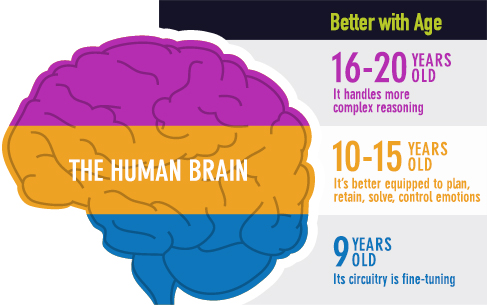 Just as the body changes dramatically between ages 9 and 20, the brain changes dramatically too. It becomes more efficient as frequently used connections strengthen and unused connections are pruned away. Development for adulthood starts at the back of the brain and moves to the front.1
Childhood to Early Adulthood
At 9 years old… The circuitry that will support the operations of an adult brain is being fine-tuned. Nine-year-olds are fortifying their ability to learn – they no longer are learning to read, but are reading to learn.2
From 10 – 15 years old… Brain development boosts several abilities - planning, retaining information, solving complex tasks and using self-control.3
From 16 – 20 years old… The brain’s ability to send and receive signals speeds up, which increases its capacity for more complex reasoning and processing.4
How Alcohol and Drugs Derail Brain Development
Studies show that exposure to alcohol and drugs during adolescence may interrupt the natural course of brain maturation and key processes of brain development. There’s evidence that suggests brain development may be more vulnerable to the effects of alcohol during adolescence, as well. The impact of drugs and alcohol on the developing brain can have harmful effects on academic, occupational and social functioning that can extend into adulthood. 5
 Consuming alcohol can change the brain’s structure and functions, altering blood flows and electrical activity. Recent research shows heavy alcohol use may affect brain functioning in early adolescence, even in youths who are physically healthy. Changes like these can impact long-term brain functioning. 6
Drugs tap into the brain’s communication system and disrupt the way nerve cells normally send, receive and process information. Different drugs work differently, and some can continue to affect the brain long after the person has stopped taking them, sometimes permanently. 7
Early recognition of substance abuse and addiction in a teen is crucial. Teens cannot be expected to understand the full range of consequences they face regarding their drug and alcohol use.